Electricity Customers Should Shop Soon to Avoid Paying Higher Rates
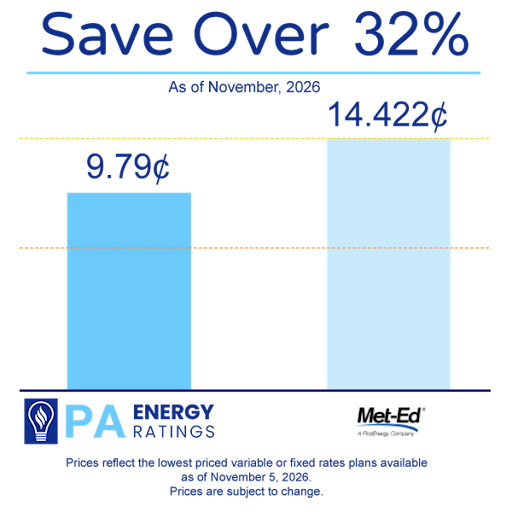
Met-Ed's Price to Compare rises to 14.422¢/kWh on December 1, one of the highest default rates in PA. For the average Reading household, that means the second-highest monthly supply bill in the state. See what it means for your bill and how to save.
Reading, PA - November 9, 2026 - While a predicted Super El Niño may help reduce the need for heating this winter, PAEnergyRatings.com is warning all Pennsylvania electric customers who stay on their utility's default Price to Compare rate that they will pay more for every kWh they use.
Starting on December 1, the Price to Compare for all of PA's major electric utilities will increase to an average of 13.76 cents per kWh. With rising food and fuel costs top of mind for many PA families, steeply rising energy rates are making it harder for them to afford their monthly utility bills. The National Energy Assistance Directors Association estimates ratepayers in PA could spend $1,249 on electricity this winter. That's $103 more than last year's $1,146.
Met-Ed customers especially face one of the costliest rate hikes. Their Price to Compare rate rises by 3.38% on December 1 to 14.422 cents per kWh. Though winter is predicted to be mild, forecasters have not ruled out bitter cold blasts from the Polar Vortex. Homes that use electric heating systems this winter will cost much more to keep warm during these cold events.
Key Takeaways
- Price to Compare rates in PA have practically doubled just within the past five years. In 2021, the default Met-Ed electric rate was 7.414 cents per kWh. On December 1, it will increase to 14.422 cents per kWh.
- According to PA PUC utility data, the average Met-Ed customer in Reading uses 930 kWh per month. This means an average default rate customer will pay about $134.12 per month in energy supply charges, the second highest in PA.
- Met-Ed customers who choose a power supplier of their own can shop 12 month plans with fixed rates below the coming December 1 Price to Compare. Many of these rates cut the average monthly supply charge by $5.00 or higher.
Why Did Price to Compare Rates Rise?
Wholesale costs across the PJM Interconnection grid jumped by 46% in early 2026, hitting $56.7 billion. Wholesale costs include the cost of the energy, capacity costs, transmission, ancillary costs, and administration. The biggest increases came from energy supply costs (up 47%) and capacity costs (up 139%).
Capacity costs are like insurance premiums that are designed to make sure power is available to meet future peak demand. PJM forecasts how much electricity it will need in the next 3 years and then lines up generators to be ready to meet that need by holding an auction to set prices. Generators are paid this price even if they are never called to supply the energy they promised.
PJM's energy supply problem stems from the grid operator retiring old fossil fuel generators faster than it could replace them. PJM is scrambling to attract companies to build more generators. The grid operator has also been struggling to modernize its process to approve new power plant connections. But electricity supplies remain tight. And as more and more AI and data centers rush to get built, the price for power is rising. And this drives up the price that generators want to be paid to meet PJM's future peak demand.
What Met-Ed Customers Can Do
PAEnergyRatings.com urges Met-Ed electricity customers from York to Pottstown to Easton to shop retail electric suppliers now to lock in the best lowest-priced, fixed rate plan that can meet their needs. Met-Ed customers that sign up with a 12 month plan at today's rate can shield themselves from costly winter cold snap bills as well as avoid unexpected summer cooling costs. Met-Ed customers should also remember the next Price to Compare rate begins on June 1, 2027. Wholesale prices leading into the PJM Capacity Auction could increase rates during the summer.
Karl Trollinger, CEO of Lumanex, adds "With many electricity consumers facing affordability problems, the last thing they need is to worry about yet another Met-Ed Price to Compare hike. We want to remind them that the Price to Compare isn't the best choice and that they can choose power supplier plans at rates they can afford. So, when it comes to fast price swings and confusing choices, we can show them how to find deals that fit their needs."
Lastly, the warmer fall temperatures are making it a far easier time to improve your home's energy efficiency. Sealing drafts from cracks, or gaps around windows and doors plus adding more insulation to your attic will help you save money on your home's energy usage.
PAEnergyRatings.com is operated by Lumanex LLC.
Lumanex LLC operates an energy management platform and a network of energy shopping websites across 11 states across 56 utilities, providing our advisory, comparison and ratings service to over 58 million residential and commercial customers. We provide our customers with the power to choose the best providers through our consumer reviews platform and provide a reliable, unbiased, source of valuable consumer insight, advice, in-depth energy company service evaluations, and personalized recommendations.
# # # Lumanex LLChttps://www.PAenergyratings.com